By Scott Callahan | AdTik Technical Stewardship
May 2026
You’re looking at the dashboard again, wondering how to adapt your AI search SEO strategy. Impressions are stable, but the clicks keep slipping.
Impressions are stable. Maybe even slightly higher than last quarter.
But the clicks keep slipping.
The outreach coordinator wonders if the messaging changed. The development director wonders if donation intent is down. Someone quietly asks whether the website needs to be redesigned again.
And beneath all of it sits the uncomfortable question:
“Did we do something wrong?”
In most cases, the answer is no.
Nothing broke.
Search changed.
If you manage a nonprofit website or a Google Ad Grants account, you’ve likely started feeling this shift already. Across nonprofit organizations, a strange pattern has emerged over the last year:
- impressions holding steady
- rankings remaining relatively stable
- but click-through rates and organic traffic quietly eroding
At first, it feels confusing.
Then frustrating.
And eventually, concerning.
Because for nonprofits, visibility is never just about traffic. Visibility affects:
- donation growth
- volunteer recruitment
- program enrollment
- community awareness
- and in some cases, even long-term grant compliance
When visibility declines, real people become harder to reach.
And the challenge is that the traditional “search, click, and read” cycle is disappearing.
In its place is something entirely different.
Search Is Becoming an Answer Engine
Over the past year, Google has accelerated the rollout of Gemini-powered search experiences and AI Overviews across an enormous percentage of search queries.
For years, search behaved like a discovery system:
- A user asked a question
- Google displayed links
- The user clicked through to explore further
Now, many users never leave the search results page at all.
The answer appears instantly:
- summarized
- organized
- simplified
- ready to consume
And for informational searches, that is often enough.
Recent studies from organizations like Ahrefs and Seer Interactive suggest that informational searches beginning with “what,” “why,” “how,” or “who” now trigger AI-generated summaries the majority of the time. Across many industries, these searches are experiencing major declines in click-through rate as AI Overviews absorb more attention directly on the results page.
For nonprofits relying on search visibility, this changes more than traffic patterns.
It changes which types of searches still lead to human connection.
Because increasingly, organizations are no longer competing only against other nonprofits.
They are competing against the search engine itself.
The Difference Between Curiosity and Need
At AdTik, we’ve found that many organizations struggling with declining traffic are still treating all searches as equal.
But they are no longer equal.
Some searches represent curiosity.
Others represent need.
And in the era of AI search, that distinction matters enormously.
A nonprofit can spend months optimizing for a phrase like:
“What causes housing insecurity?”
But the person searching:
“Need emergency housing tonight with children”
is living in an entirely different emotional reality.
One search is educational.
The other is immediate.
One can be satisfied by information alone.
The other requires trust, proximity, reassurance, and action.
And increasingly, those are the searches AI cannot fully resolve on its own.
At AdTik, we often describe this shift through two behavioral categories:
1. Passive Curiosity (Satisfied by AI)
These are searches driven primarily by information gathering.
Examples:
- “What is a community land trust?”
- “How does food insecurity affect children?”
- “What causes anxiety?”
For these searches, AI Overviews often function very effectively.
The user receives a concise explanation, scans the answer, and moves on without ever visiting a website.
No relationship begins. Your organization never enters the conversation at all.
At AdTik, we call this Connection Interception:
Connection Interception: When AI-generated search results satisfy a user’s question before they encounter the organization capable of helping them act on it.
The user got the “what,” but they missed the “who.”
They never saw your housing intake form.
They never discovered your support group.
They never learned your nonprofit exists to help people through this exact situation.
This is one of the defining challenges of AI search in 2026.
2. Active Need (Driven by Human Intent)
Other searches carry emotional urgency.
A parent searching for emergency rental assistance at 11:43 PM behaves very differently than a student researching a school assignment.
One search is exploratory.
The other is emotionally loaded.
And emotionally loaded searches still require human systems, human organizations, and human trust.
These searches sound different:
- “Affordable housing programs near me open today”
- “Where can I get help paying utilities right now?”
- “Volunteer opportunities for teens this weekend”
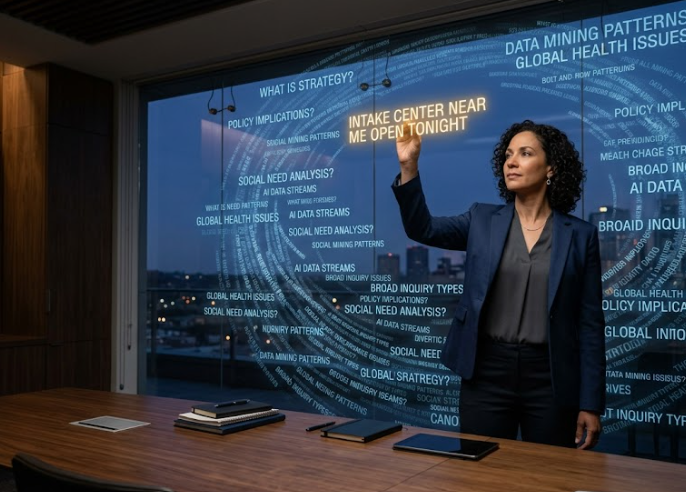
- “Emergency food assistance near me tonight”
At AdTik, we refer to these as Intent-Driven Searches.
Intent-Driven Search: A search query where the user is actively attempting to solve a real-world problem, access a service, or take meaningful action.
AI can summarize information.
But it cannot:
- physically provide shelter
- coordinate volunteers
- process a pantry intake
- counsel a struggling family
- build trust during moments of uncertainty
That distinction is becoming one of the most important strategic realities in nonprofit marketing.
Ironically, AI search may actually increase the long-term value of deeply human organizations.
As generic information becomes infinite and instantly accessible, trust, specificity, locality, and real-world connection become more important—not less.
You Aren’t Losing to Competitors
One of the hardest parts of this transition is psychological.
Because from inside the organization, declining traffic feels personal.
The instinct is to assume:
- the messaging stopped working
- the ads became weaker
- another nonprofit outperformed you
- your team failed to keep up
But in many cases, that isn’t what happened.
You aren’t losing to a competitor.
You are losing to an algorithm that answers the question before the user can scroll to your link.
That distinction matters because it changes the solution entirely.
The answer is no longer:
“publish more information.”
The answer is:
“become more aligned with human intent.”
What Modern Stewardship Actually Looks Like
At AdTik, we’ve found that organizations adapting successfully to AI search are making a deeper strategic shift.
They are moving away from:
- broad informational visibility
- generalized awareness traffic
- passive educational content
And moving toward:
- intent-driven engagement
- first-party expertise
- real-world outcomes
- human-centered search experiences
This is not about “gaming the algorithm.”
It is about recognizing that people search differently in moments of real need than they do during casual curiosity.
And the organizations that understand that distinction are far more likely to remain visible as AI search continues evolving.
1. Stop Chasing Searches That End on Google
Many nonprofits are still heavily targeting broad informational keywords through both SEO and Google Ad Grants campaigns.
The problem is that these are exactly the types of searches AI Overviews are designed to intercept.
If your content strategy is centered around:
- “What is…”
- “How does…”
- “Why do…”
you are increasingly competing against AI-generated summaries that eliminate the need for a click.
At AdTik, we recommend shifting toward long-tail searches that signal readiness to act.
Not:
“What is food insecurity?”
But:
“Find emergency food assistance near me”
The second search contains urgency, locality, and intent.
And those are significantly harder for AI systems to fully satisfy inside the search results page alone.
2. Measure Commitment, Not Just Clicks
One of the biggest mistakes organizations make in 2026 is continuing to optimize around shallow engagement metrics.
A page view is not the same thing as meaningful action.
At AdTik, we encourage nonprofits to stop measuring shallow attention and start measuring moments of real commitment.
That includes:
- completed intake forms
- volunteer registrations
- donation completions
- appointment requests
- event signups
Tools like Enhanced Conversions and value-based optimization matter not because they are trendy marketing tactics, but because they help search systems recognize meaningful human engagement instead of empty traffic volume.
The goal is not more clicks.
The goal is more connection.
3. Build Around First-Party Truth
AI systems are becoming increasingly capable of summarizing generic information.
What they struggle to replicate is lived experience, local expertise, and organizational trust.
That means the nonprofits most likely to remain visible are the ones publishing content rooted in what we call First-Party Truth.
At AdTik, we define First-Party Truth as:
Original, experience-based information that cannot be easily replicated or summarized by generic AI systems.
This includes:
- real case studies
- community impact reports
- step-by-step program access guides
- local resource coordination
- firsthand operational insight
The more uniquely human your content becomes, the more likely search systems are to view your organization as a primary source rather than a secondary summary.
Technical Stewardship Is Still a Human Conversation
At the end of the day, a Google Ad Grant is not just a marketing platform.
It is an operational bridge between your mission and the people searching for help.
And if you’re wearing twenty different hats to keep your nonprofit running right now, it is completely understandable to feel overwhelmed by how quickly the digital landscape is changing.
You do not need to become a machine learning expert to adapt successfully.
You simply need a strategy grounded in how people actually search during moments of uncertainty, urgency, and need.
Because the future of nonprofit visibility will not belong to the organizations that publish the most information.
It will belong to the organizations that understand the difference between being visible… and being needed.
When someone searches during a difficult moment, they are rarely looking for perfect information.
They are looking for a way forward.